Profile
Takashi Kokubo is a pioneering Japanese ambient music composer and sound designer, internationally recognized for his work in environmental music, healing soundscapes, and immersive audio. Since the 1980s, he has continuously explored the relationship between nature and human perception through sound.
His work goes beyond conventional music, focusing on “designing the environment itself through sound.” His compositions create deeply immersive listening experiences that resonate with both the mind and body. From an early age, Kokubo was fascinated by natural and everyday sounds, leading him to develop a unique approach to three-dimensional audio expression using synthesizers and advanced recording techniques. His early works in the 1980s established him as a visionary artist often described as “a composer who visualizes the sounds of the Earth.”
His notable works include the Ion Series, which introduced therapeutic and healing music experiences, and Oasis of the Wind, which explores the harmony between urban life and nature. These works have gained renewed global attention in recent years within the ambient and new age music communities.
In addition to his music career, Kokubo has an extensive portfolio as a sound designer. He has created sound logos for major corporations, acoustic designs for public spaces, and audio works for international exhibitions and museums. Notably, his emergency earthquake alert sound in Japan is widely recognized as an iconic example of functional sound design.
Using his original 3D recording system known as “Cyberphonic,” Kokubo has conducted field recordings of natural environments in over 50 countries. These recordings are compiled in his Gaia Series, offering listeners immersive nature-based sound experiences and forming the foundation of his music and installation works.
In 2020, he participated in the compilation album Kankyō Ongaku: Japanese Ambient, Environmental & New Age Music 1980–1990, released by Light in the Attic Records. The album was nominated for a Grammy Award (Best Historical Album), contributing to the global recognition of Japanese ambient music.
Currently based at Studio Ion, Kokubo produces immersive audio works using a Dolby Atmos (7.1.4) system. His recent projects, including Gaiaphilia, Mother Tree, and JOMON DIVA, explore themes of nature, life cycles, and human consciousness through multidisciplinary installations that combine sound, visuals, scent, and light.
His upcoming book, Designing with Sound (Kodansha, scheduled for February 2026), presents his philosophy and practice as a sound artist.
Takashi Kokubo’s work transcends entertainment, positioning itself as an environmental art form that reconnects humans with nature. Bridging music, science, and spirituality, he continues to expand the possibilities of auditory experience for the future.
.
.
“Digital Bach” (with Kazutaka Tasaki) (King Records)
.
Composer and sound artist Takashi Kokubo is known for his unique sonic world that blends natural and electronic sounds, exploring an art form that invites listeners to hear space and time. Italian composer and trombonist Andrea Esperti moves freely between classical and ambient music, earning international acclaim for his rich overtones and meditative resonance.
Their collaboration unfolds as a sonic dialogue where East and West, nature and technology intersect—creating an experience akin to a “sound retreat” that liberates the mind through listening.
Composer and sound artist Takashi Kokubo is a sonic explorer who has opened new dimensions in auditory space by blending natural and electronic sounds. Pianist Yumiko Morioka is known for her delicate touch and deeply expressive musicality, with a repertoire spanning from classical to contemporary music.Their collaboration forms a “dialogue of silence and resonance,” where sculpted sound and refined sensibility intertwine. Universal themes—nature, time, memory—are transformed into music that leaves a lasting echo in the listener’s heart.This sound world, born from the harmony of stillness and motion, reason and emotion, is truly deserving of the name “the art of listening.”
Composer and sound artist Takashi Kokubo is a pioneer who has created immersive acoustic environments centered on the fusion of nature and technology. Sound engineer and artist Naoki Tate is known for his exceptional recording techniques and refined sensitivity to sound, continually exploring its physical and psychological dimensions.Their collaboration is not about designing sound, but about allowing sound to be experienced as a place. Through the intersection of precise engineering and deep artistic intuition, they create a new kind of auditory experience—an art form in which the space itself resonates and envelops the listener.
JOMON DIVA is a sound-art project that fuses the spirit of the Jōmon era with contemporary technology. It reconstructs Jōmon sensibilities—ancient prayer, coexistence with nature, the cycle of life—into a modern acoustic expression, creating a listening experience that transcends music itself.Within a three-dimensional immersive sound space, primordial rhythms and electronic tones resonate together, awakening humanity’s inner memory and future sensibility.JOMON DIVA. is an art project of prayer and renewal—reviving “the mysterious sounds of ancient times” for the present day.
Dissatisfied with the limitations of two-channel recording—which cannot fully capture three-dimensional sound information such as height and front-back positioning—Takashi Kokubo developed his own binaural recording device, the Cyborphonic (nicknamed Cyber-kun), in the early 1980s. Designed to replicate the human auditory environment and record more natural sound fields, this device became his constant companion as he traveled to roughly 50 countries around the world, pursuing his life’s work: capturing “natural quiet,” the pure sound of nature free from artificial noise.Kokubo’s quest to preserve the breath of the earth and the voices of the wind in their original form transcended mere recording technique. It is widely regarded today as an artistic endeavor to perceive the resonance between nature and human beings.
Cyberphonic Comfort Channel

AMANE is an ambisonic microphone capable of capturing full three-dimensional sound information from an entire space. It records front–back, up–down, and depth cues that conventional stereo cannot reproduce, delivering an immersive sense of “being there.” Sixteen high-precision microphone units are arranged in a spherical layout, analyzing direction, distance, and reflections in real time. From natural soundscapes and environmental audio to music production and film recording, it captures the space itself.The name AMANE conveys the idea of “waves of sound spreading outward,” embodying a next-generation recording experience that revives the ancient, mysterious voices of the natural world.
Welcome to Immersive-audio world

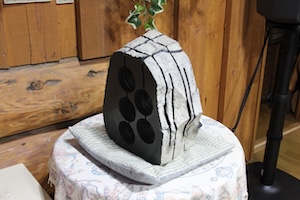
Sanukite is an extremely rare stone with unique properties, found in Kagawa Prefecture (the former Sanuki region). Formed about 14 million years ago, it originated from lava that flowed during volcanic activity in the region and was then subjected to intense underground pressure over an immense span of time.
Its most distinctive feature is its ability to produce a clear, metallic high tone despite being stone. This unique resonance comes from the pressure-structured formation process. Once crafted, it can be played as a percussion instrument, generating a wide range of tones depending on where and how strongly it is struck.
With no fixed scale and a freely resonating tonal character, Sanukite carries within it the memory of 14 million years and the voice of the earth, offering listeners a profound sense of stillness and mystery.